By Suhas Das
Author
Loading PDF book...
Introduction to Documentum
OpenText Documentum is a powerful enterprise content management (ECM) platform designed to help organizations manage, store, and control large volumes of digital content efficiently.
At its core, Documentum provides robust content management capabilities, including:
- Check-in and check-out control for collaborative editing
- Version management to track document history
- Workflow automation to streamline business processes
- Metadata management to organize and classify content
Managing Diverse Content Types
One of Documentum’s key strengths is its ability to handle a wide range of content formats. These include:
- Business documents (PDFs, Word files, reports)
- Images and multimedia (videos, graphics)
- Emails and communications
- Web content and HTML pages
- XML-tagged and structured documents
This flexibility allows organizations to centralize all their information in a single, unified system.
The Content Repository
At the heart of Documentum lies the content repository, a secure and scalable storage system where all content is maintained.
The repository:
- Stores both content files and metadata
- Enforces security and access controls
- Supports compliance and regulatory requirements
- Ensures data integrity and auditability
This centralized repository acts as the backbone of the entire platform, enabling consistent access and governance of enterprise content.
Comprehensive Content Services
Beyond basic storage, Documentum offers a wide suite of enterprise services that enhance productivity and collaboration:
- Document Management → Organize, store, and retrieve documents
- Collaboration Tools → Enable team-based content creation and sharing
- Search and Classification → Quickly locate and categorize content
- Business Process Management (BPM) → Automate workflows and approvals
- Web Content Management → Manage digital experiences and websites
- Digital Asset Management → Handle multimedia content efficiently
- Forms Processing & Input Management → Capture and process incoming data
- Information Rights Management → Control access and usage of sensitive data
- Compliance & Archiving → Meet legal and regulatory requirements
Documentum Three-Tier Architecture
Docbases follow a three-tier architecture:
-
Client Layer (Top):
Client applications allow users to create, edit, and view documents, as well as manage metadata. -
Content Server Layer (Middle):
The Content Server processes requests from client applications. It contains the application logic and interacts with the database through server API calls. -
Data Layer (Bottom):
The RDBMS and operating system store and manage data. Content is saved either in the file system or within database tables.
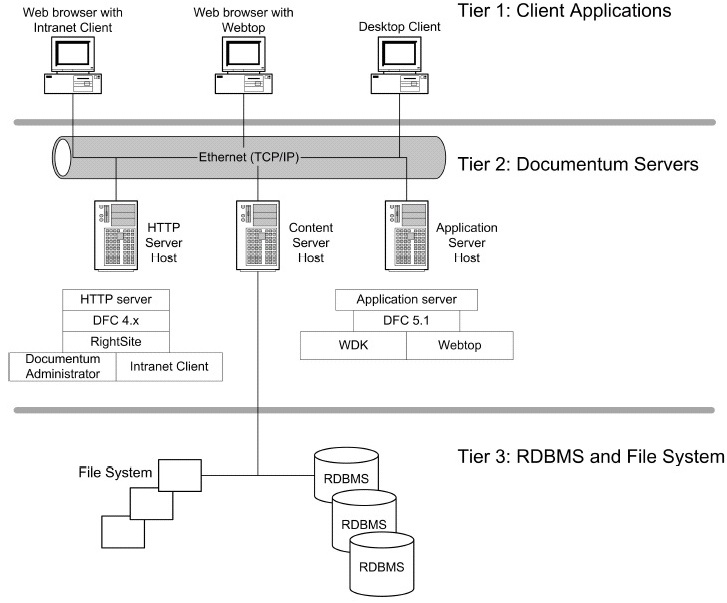
The OpenText Documentum platform follows a three-tier client/server architecture, designed to efficiently manage, store, and retrieve enterprise content. This architecture separates responsibilities across layers, ensuring scalability, performance, and maintainability.
1. Client Application Layer
The client application layer represents the front-end interface where users interact with the Documentum system.
At this level, users can:
- Create and edit documents
- Search and retrieve content
- View and update metadata
Client applications—whether web-based interfaces, desktop tools, or custom apps—communicate directly with the Content Server to perform these actions.
When a user initiates an operation (such as opening or editing a document), the client sends a request to the server. The server processes the request and returns the appropriate response, enabling seamless interaction between the user and the underlying content repository.
2. Documentum Content Server Layer
The Documentum Content Server acts as the core of the system, handling all business logic and content operations.
Its key responsibilities include:
- Managing read and write operations
- Enforcing security and access control
- Processing client requests
- Coordinating with the repository and storage layers
Communication between the client and server typically occurs over HTTP or HTTPS protocols, ensuring secure and standardized data exchange.
The server leverages Documentum Foundation Classes (DFC) APIs to interact with repositories. These APIs provide a consistent way to execute operations such as querying, storing, and modifying content within the system.
By centralizing application logic in this layer, Documentum ensures consistency, reduces redundancy, and simplifies client-side development.
3. RDBMS and File System Layer
At the foundation of the architecture lies the RDBMS (Relational Database Management System) and the file system.
This layer is responsible for:
- Persisting metadata in relational database tables
- Storing actual content files in the file system
- Handling low-level data operations and storage management
The Content Server communicates with the RDBMS to execute queries and manage structured data, while the file system stores the physical documents.
Together, the operating system and database layer process all storage-related requests and ensure that content is securely maintained and efficiently retrievable.
Conclusion
The Documentum architecture is built on a clear separation of concerns:
- Client Layer → User interaction and request initiation
- Content Server Layer → Business logic and content management
- RDBMS/File System Layer → Data storage and persistence
This layered approach allows organizations to manage large volumes of enterprise content reliably, while maintaining flexibility for customization and integration with other systems.